
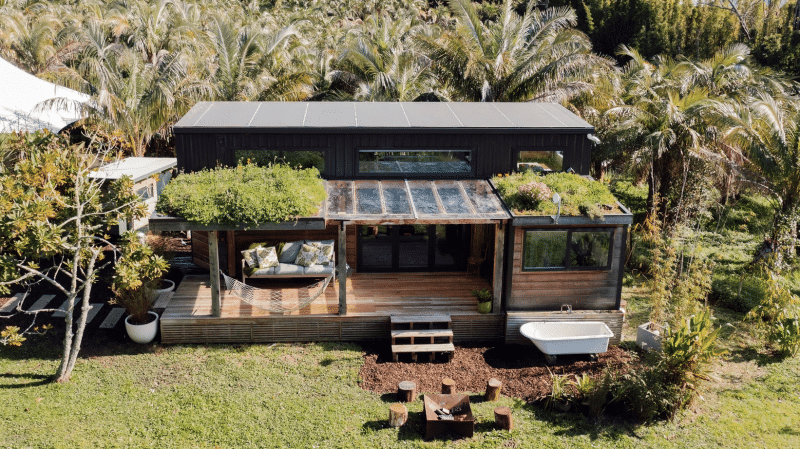
The Tiny Home is seen as an affordable pathway to homeownership. Particularly as we watch the price of traditional homes heading for the stratosphere. Here’s what we found out about how to make your homeownership dream a reality with a Tiny Home.
The Tiny Home is ideal. Everything in its place, no more than you need. Simplicity made real.
Who wants Tiny Houses?
A surprisingly wide-ranging set of people are moving to this style of living. Young people starting out, older people hitting or nearing retirement and wanting to free up capital, people moving on from a previous relationship or someone wanting a spare self-contained space for an elderly parent, independent teen or simply to rent out for extra income.
As you’d expect, Tiny houses cost less to build because they use less of everything – although they’re actually more expensive on a per square metre basis because things like kitchens and windows don’t get spread out over a larger footprint.
These days, however, there’s definitely a swing to Tiny Homes as a stepping stone—either something that is to be sold on when upscaling, or as something that can be added on to as needs grow with a family, or something that is an easier lifestyle for older homeowners and that lowers debt or frees up capital for retirement.
Key things to know about building a Tiny House
If you build a Tiny House to live in and hook up water and sewage and power, it’s still a ‘house’. It will need to be consented and it will have to meet the building code.
Tiny Houses with wheels become caravans but there’s still a need to keep up with roadworthiness – let’s face it – you want to have something that’s warm, doesn’t leak and is safe to tow.
Then there are design considerations if you have your home as transportable. Windows at the front of the house are not a great idea because of the wind when you’re towing it. Mono- or high-pitch roofs are gaining popularity because you can squeeze a loft room in, but keep in mind that trees grow over roads, so how high can you go and still be safe?
Waka Kotāhi (NZ Transport Agency) has clearly defined dimensions around trailers that have a strong influence on the size of your transportable home. https://www.nzta.govt.nz/vehicles/vehicle-types/vehicle-classes-and-standards/vehicle-dimensions-and-mass/light-trailers/
Then there’s the reality of living in a house that’s about the size of an average bedroom. How are you going to fit everything in, including toilets, beds, chairs and kitchen, cupboards, fridge and a TV!
You can spend between $35,000 if you do a lot of work yourself, or up to $200,000 to get a highly specced, professionally built home. That’s still a lot cheaper than even a group home builder’s cheaper end regular-sized home by a lot!
Key elements to include
If you’re building a house on a trailer you’re likely to need a ‘subfloor’ to minimise rust. You’re going to need a Warrant of Fitness and a Warrant of Electrical Fitness. If you’re wanting higher power usage for coffee machines and heating, then you’ll want a 32amp power supply.
One of the most important elements of your new home is the outdoor area. If you have a deck of some sort then it becomes your living room. But if your deck is attached to your caravan, that would make it a permanent structure and then you’re back to needing a building consent.
Building a tiny house is a fabulous exercise but there are rules and considerations – it’s not a simple task. Think through how you live and incorporate that into your design. Choose your builder well.
Done right, you’ll love it.